
Note: Some of the info below related to Par’s history and dating is based on Anne William’s articles and publications she has written on Par Puzzles. A huge thank you to Anne for all the invaluable information she has shared over the years!
We get questions about vintage Par puzzles from longtime collectors and people discovering them for the first time.
To help answer these questions and provide some information to the puzzle community, we’ve put together a collection of questions and brief answers, based on puzzles we’ve handled, assembled, and researched over the years. Enjoy!
Why do some Par puzzles have a piece that spells out “PAR”?
Some of the earlier Pars we’ve come across include both a seahorse and a separate piece spelling out “PAR.” Many other examples have the more familiar pair of seahorse signature pieces.
We haven’t pinned down exactly when that combination changed, but the ones we’ve come across seem to be earlier Pars. It’s hard to date Pars exactly (see next question) but the puzzles we’ve seen this piece appear to be from pre-1945 or so given the labels that correspond to the box.

How do you date a vintage Par puzzle?
This is a quick overview rather than a comprehensive guide.
The first place to start is with the labels:
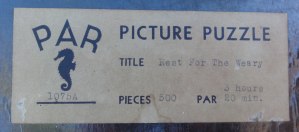
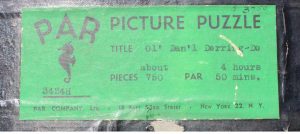
The oldest Pars usually have what looks like a very light brown label that originally was a light green that has faded over the decades. These labels generally indicate Pars made up until 1945, give or take. (Note that there were at least two versions of the label lids at this time as well.)
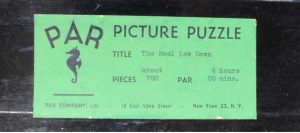
Par then came out with the dark green labels which, are the most common labels we see. Notice the switch to the early zip code of just “22”! These were used from about 1945 until around 1970.
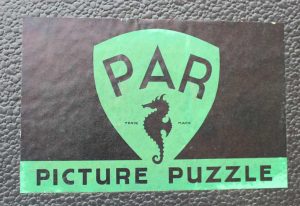
The more modern era of Pars, around 1970 saw several changes, including replacing the smooth surface of the black box to a textured version. The company moved out of Manhattan in the 1970s and the labels no longer showed that address (it was cut off per Anne’s research). Finally they were changed entirely to the white and gold style in the 1990s. (We actually don’t see very many Pars post early 1970s.)
Beyond the labels, there are also some other clues you can use to date Pars:
*Previous owners sometimes recorded when they completed the puzzle and how long it took inside the lid. This at least gives some indication of age, although it is not definitive.
*Identifying the artist and when the image was created gives you an earliest possible date. A painting from 1952 couldn’t have appeared on a puzzle made in 1940, obviously, but it could have been used decades later.
*If you can identify the original poster and its publication date, that gives you another starting point. Be careful to distinguish an original printing from a later reproduction. Make sure to check our guide on how to do reverse image searches
The strongest dating estimates come from several clues together. Sometimes we can narrow a puzzle to a decade; other times, a broader date range is the best we can find.
Can anyone actually finish a puzzle in the Par time?
We hear this one fairly often. The answer? Sometimes!
The original Par times were based on co-founder John Henrique’s puzzle solving ability. He was, reportedly, what we would call a speed puzzler today! Supposedly, he put together the puzzles in the early days and timed himself. As business picked up it sounds like he didn’t have the time to assemble them so the times became estimates. If you’ve ever only got halfway through a Par and are at double the Par time already, you may have the feeling of defeat, don’t worry it not an uncommon occurrence!
In our experience, solving the puzzle under the Par time for smaller puzzles with more straightforward images can be achievable. Once you get into larger puzzles or difficult artwork, though, that number on the label can start to feel pretty ambitious. We’ve found that a challenging puzzle of 1,000-plus pieces can easily take one and a half to twice the stated time—or longer.
We say: treat it as a challenge, not a deadline. There’s no penalty for enjoying your puzzle at your own pace!
How do I choose a Par if I’ve never done one?
Start with an image you actually want to spend time looking at. That sounds obvious, but an appealing picture can make a difficult puzzle much more enjoyable.
We’d also suggest starting with around 500 pieces while you get familiar with the cutting style.
One feature that takes some getting used to is line cutting, where the cut follows the boundary between two colors or objects. Some interior pieces can also look surprisingly like edges because of this.
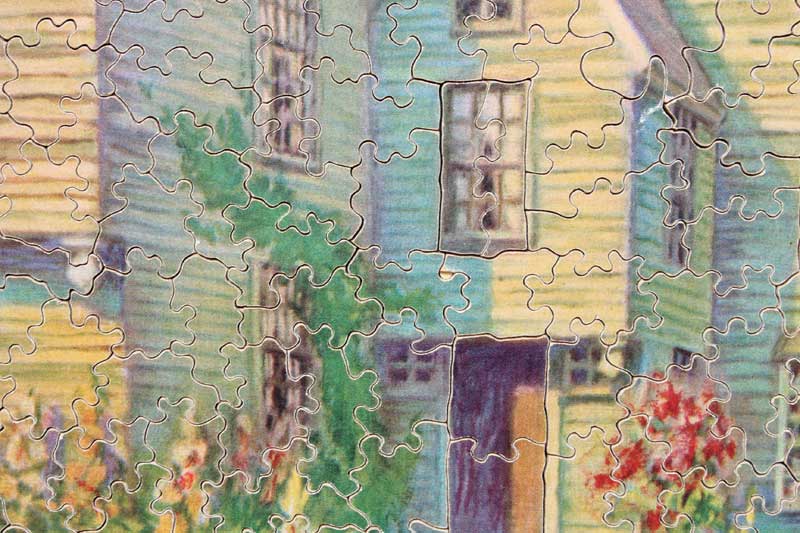
A smaller Par can still give you plenty of challenge. There’s no need to start with the biggest one in the room.
How much harder are puzzles with irregular edges?
They can add quite a bit of difficulty, especially when the entire edge has no straight pieces.
With a conventional rectangular puzzle, finding the corners and building the border gives you a good starting point. Irregular edges take away much of that advantage. You may not immediately recognize an outside piece, and the finished outline can be a surprise of its own.
That extra challenge is part of their appeal. We find these puzzles particularly interesting because the outline becomes part of the design, rather than simply a frame around the picture.
For a first Par, a more conventional outline may be an easier introduction. Once you’ve gotten comfortable with the cuts, an irregular-edge example makes a fun next step.

Why do some labels have a serial number in the lower-left corner?
In addition to selling puzzles, Par operated a rental business. Numbers on rental labels helped identify and track the puzzles.
Par periodically sold puzzles out of its rental inventory at lower prices than new examples. That means some vintage Pars available today have a history of being shipped, assembled, and returned by numerous puzzlers.
An ex-rental isn’t automatically in poor condition. It may be “well-loved” as we like to say, so do pay attention to condition details when considering an ex-rental.
What does “uplifting” mean in a puzzle description?
We use “uplifting” to describe areas where the printed paper image has begun lifting away from the wood, often along a piece’s edge or around a delicate connector.
It can range from a tiny raised spot to a more noticeable area of separation. It’s different from a chip: with uplifting, the paper may still be present but no longer lying flat.
Minor uplifting can sometimes be stabilized by someone experienced in puzzle restoration.
What if a piece is missing?
A missing piece doesn’t mean the end of the puzzle.
Skilled restorers can make a replacement that fits the opening and recreate the missing artwork by matching the colors and image by hand.
The work can be remarkably good, although the outcome depends on the puzzle and the complexity of the missing section, not to mention the skill of the crafter, who must both be a quality puzzle cutter and someone with an eye for color.

How are vintage Par puzzles valued?
There isn’t a simple formula. Two puzzles of similar size can have very different values.
Condition and completeness are major considerations, but we also look at the artwork, cutting style, silhouette pieces, unusual borders, size, and overall appeal. Original boxes and labels contribute to the package, while repairs or replacement pieces need to be considered individually.
Age alone doesn’t make a puzzle more valuable, and difficulty doesn’t automatically translate into a higher price. Some buyers want the toughest challenge they can find; others care more about the image or an especially creative cut.
Ultimately, value comes from the combination of those features and what buyers are willing to pay for that particular puzzle.
Why do some Pars have initials or names cut into them?
Par offered personalized puzzles, and customers could have initials, monograms, names, or significant dates incorporated into the design.
Sometimes the personalization appears as a shaped piece. Other times, letters form a **drop-out** which is an intentional open space within the puzzle. In that case, you aren’t missing a piece. The empty area is part of the finished design.